
A machined part exits the washer carrying rinse water in every threaded hole, every pocket, every recessed face. The question is not whether the water needs to come off. It does. The question is what force actually removes it, and whether the method you are using is doing that job efficiently.
Heat, fans, and compressed air each have a role on the plant floor. For continuous parts drying on a production line, none of them match the physics of high-velocity blow-off. Here is why.
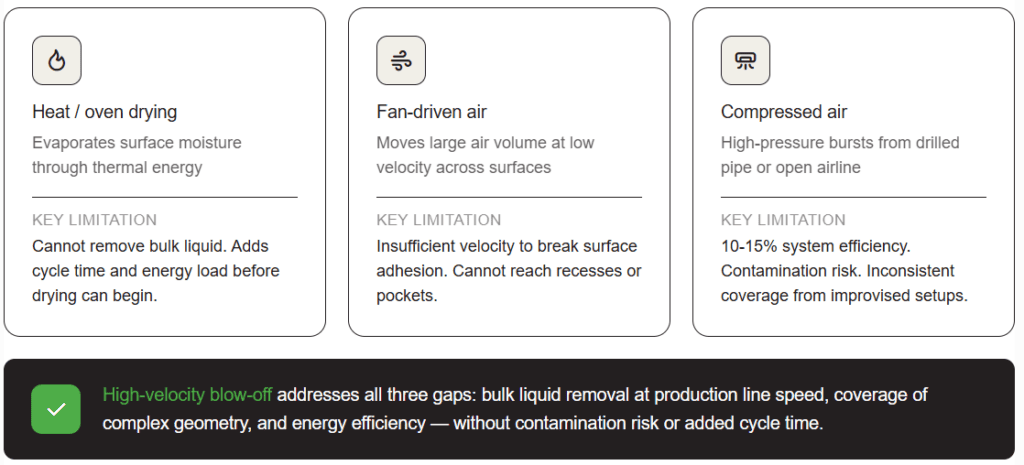
The Three Ways Plants Dry Parts (and Where Each One Breaks Down)
Most facilities rely on one of three approaches. Each has a real limitation that becomes a production problem at scale.
The Physics of Why Liquid Stays on a Metal Surface
Before you can remove liquid from a part, you need to understand why it is there in the first place. Two forces work against you.
The first is surface tension. Water molecules are strongly attracted to each other. At the surface of a water droplet, those molecules pull inward, creating a kind of elastic skin that holds the droplet together. Water’s surface tension measures approximately 72 dynes per centimeter at room temperature, per physics data from Lumen Learning’s College Physics resource. That is strong enough to keep water clinging to a steel surface rather than running off freely.
The second is adhesion. When water contacts a metal surface, the water molecules are attracted not just to each other but to the metal itself. That attraction is what causes a water droplet to spread flat on bare steel rather than bead up. The contact angle between the water and the surface tells you how strong that adhesion is. A low contact angle means the water is spreading and clinging. That is exactly what happens on a freshly washed metal part.
Together, surface tension and adhesion create a film of liquid that does not want to move. Fan-driven air at low velocity cannot generate enough force to overcome both forces simultaneously. Heat evaporates the liquid eventually, but it cannot do it fast enough to keep pace with a production line. Only a directed, high-velocity air stream generates the shear force needed to break both bonds and physically displace the liquid.
Velocity Is the Variable That Matters
This is the core of the science. Drying is not a volume problem. It is a velocity problem.
The force an air stream exerts on a liquid film increases with the square of the air velocity. Double the velocity, and the force on the liquid surface quadruples. This relationship comes directly from basic fluid dynamics, where dynamic pressure (q) equals one half the air density times velocity squared:
q = ½ρv²
In plain terms: a small increase in air velocity produces a large increase in the force applied to the liquid. This is why a high-velocity blower system outperforms compressed air and low pressure fan type centrifugal blowers. The high-velocity air produced by Maxum equipment generates the ideal ratio of velocity and volume with the least possible energy used.
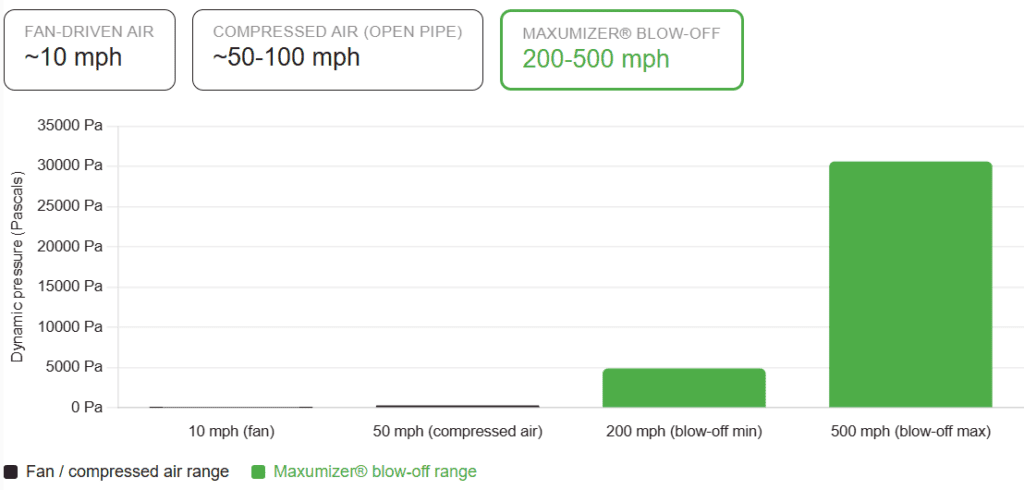
Maxumizer® Air Blower systems deliver air velocity in the 200-500 mph range at the point of application. At 200 mph, the dynamic pressure applied to a liquid surface is roughly 400 times greater than fan-driven air at 10 mph. That is not a marginal improvement. It is a different category of force entirely. Compressed air can provide this higher velocity, but at an energy cost ten times higher or more than Maxum high-velocity blow-off equipment.
Why Laminar Flow Beats Turbulent Air at the Surface
Velocity alone is not the whole equation. How that air is delivered matters just as much.
Turbulent air, the kind that comes out of a drilled pipe or an open airline, scatters in multiple directions when it exits. Some of that air hits the part surface. A lot of it deflects sideways and loses energy before it can do useful work. The result is inconsistent coverage, wasted airflow, and dry spots where the turbulence did not reach.
Laminar flow is different. In laminar flow, air molecules travel in parallel layers, maintaining direction and velocity all the way to the surface. When that sheet of air contacts a wet part, it applies consistent force across the full coverage area without energy loss from turbulence.
The teardrop-shaped plenum design used in Maxumizer® Air Knives achieves a coefficient of discharge greater than 90%— meaning over 90% of the energy put into the system reaches the surface as useful airflow. A drilled pipe, by comparison, achieves roughly 60%— meaning 40% of the energy is lost before it reaches the part.
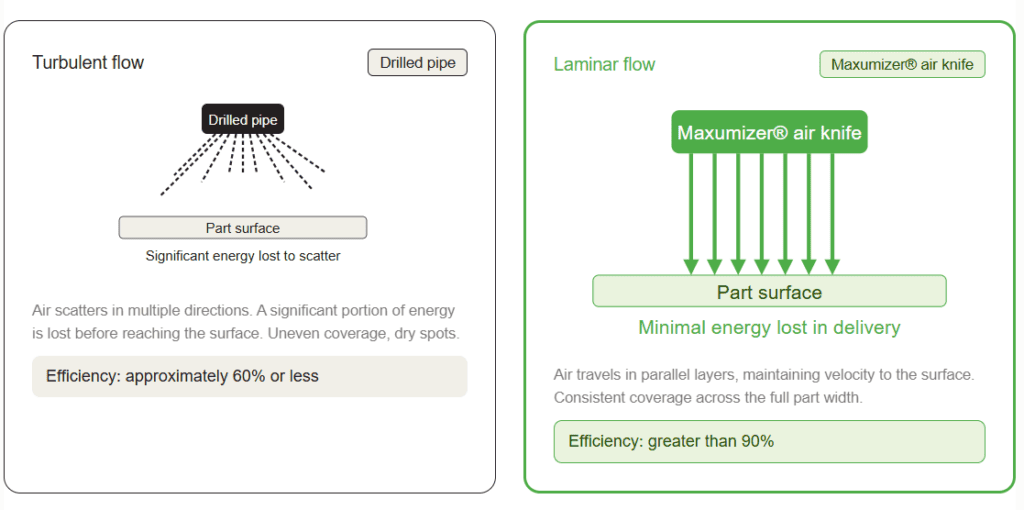
The practical result of laminar flow at high velocity: liquid is stripped from the surface in a single pass rather than pushed around by chaotic air that partially misses the target.
Why Debris Removal Follows Different Rules
Liquid removal and debris removal are related problems, but the physics are not identical.
A water droplet on a metal surface is held in place primarily by surface tension and adhesion. Sufficient air velocity breaks both. A metal chip or dust particle is held by a different set of forces: friction, electrostatic attraction, and its own mass relative to its contact area with the surface.
The key variables for particle removal are:
- Mass-to-contact-area ratio. A thin, flat chip has high contact area relative to its mass, making it harder to dislodge than a round particle of the same weight.
- Electrostatic charge. Fine particulate in machining environments often carries a static charge that increases adhesion to the metal surface. High-velocity airflow disrupts this by physically lifting the particle before the charge can re-anchor it.
- Air stream concentration. Debris in recesses and pockets requires a concentrated, directed air stream, not broad coverage. A wide air knife handles flat surface debris. Complex geometry requires nozzle-based coverage to reach the particle where it sits.
This is why Maxumizer® Air Nozzles are often used alongside air knives on machining and deburring lines. (internal link: https://maxumair.com/maxumizer-air-nozzles/) The air knife handles broad surface coverage. The nozzles reach into bores, holes, and pockets where a sheet of air cannot penetrate.
How Surface Geometry Changes Everything
Flat parts and complex parts do not dry the same way. This is one of the most overlooked variables in selecting a blow-off system.
A flat conveyor product, like sheet steel, plywood, tile and others presents a consistent surface at a predictable distance from the air knife. The coverage geometry is simple. A standard air knife handles it well.
An automotive bracket, a machined casting, or a plated rack presents dozens of different surface angles, recesses, and through-holes in a single part. The air knife covers the exposed faces. The recesses trap liquid that the sheet of air cannot reach at the right angle.
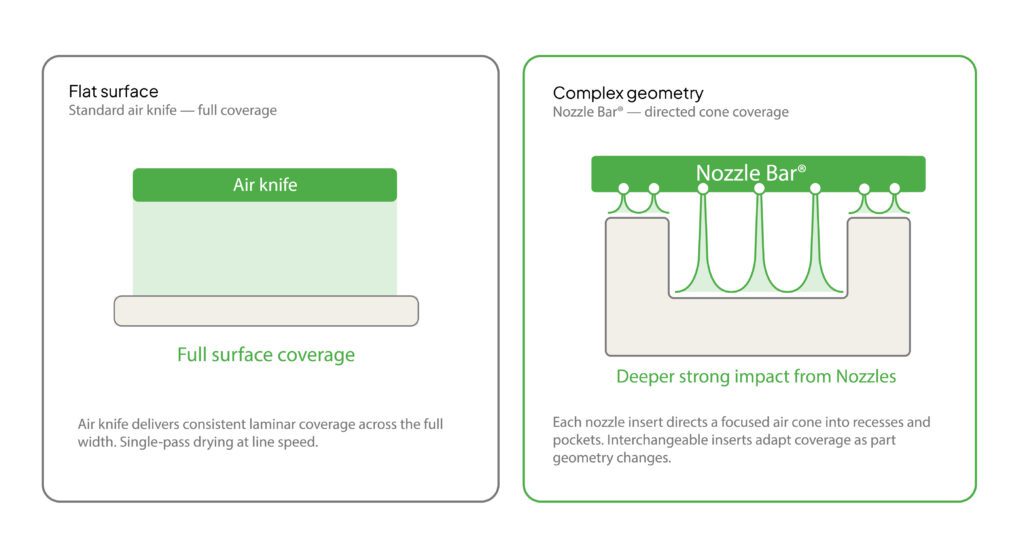
The Nozzle Bar® Air Knife System addresses variable geometry through a patented internal converging and laminar flow design that accelerates air through individual nozzles. Nozzle patterns are interchangeable, so the system adapts as the product mix changes without replacing hardware. That is not a convenience feature. It is a direct response to the complex and variable depth geometry problem that standard air knives cannot solve.
What This Means for Line Speed and Throughput
The physics of parts drying have a direct production floor consequence: if your drying system cannot keep pace with your conveyor, it becomes the bottleneck.
Heat drying adds dwell time. Fan drying requires multiple passes or extended exposure. Compressed air from drilled pipe produces inconsistent coverage that leaves wet spots requiring rework or rejection downstream.
High-velocity blow-off removes bulk liquid with optimized energy efficiency. That is the output Maxum’s systems are engineered to deliver. The result shows up in three measurable ways:
- Coating adhesion improves because surfaces arrive at the paint or powder line dry, not carrying residual rinse water that causes fisheye defects and water stains under the coating. See the Powder Paint Blow-Off Success Story.
- Label and inkjet reliability improves because moisture on a can or bottle before coding causes adhesion failures and misreads. See Beverage Solutions and the Beer Case Can Blow-Off Success Story.
- Oven load decreases because parts arrive drier, meaning less energy in the drying oven, and improved quality in the final curing oven. See the wash-to-coat blog for the full breakdown of that cost.
This is also where Maxum’s 100% dryness standard comes from. Competitors using fan-driven or compressed air setups may achieve 50-60% dryness, leaving residual moisture that creates downstream defects. A properly configured Maxumizer® system is designed and sized to achieve complete surface dryness for the specific application, not approximate dryness.
Matching the Right System to Your Application
The science narrows to four variables that determine which system configuration is right for a specific line.
- Part geometry. Flat and consistent surfaces are handled by Maxumizer® Air Knives. Complex, variable, or recessed geometry requires Nozzle Bar® coverage, sometimes in combination with air nozzles for through-holes and bores.
- Line speed. Faster conveyors require higher air velocity or longer coverage zones to achieve full dryness. System sizing accounts for dwell time under the air knife.
- Liquid type. Water-based rinse solutions behave differently than stamping oils or quench fluids. Surface tension and viscosity both affect how much force is needed to displace the liquid. Oil has lower surface tension than water but higher viscosity, which changes the velocity requirement at the surface.
- Downstream sensitivity. Food and pharmaceutical contact applications have compressed air quality requirements that may be reduced by choosing blower-driven systems. Coating and painting applications are more sensitive to surface moisture than packaging applications. System configuration accounts for what comes after the drying step, not just the drying step itself.
Maxum’s team works through these four variables before a quote. The engineering determines the system configuration. See Industrial Solutions and the Industrial Grind Deburr Blow-Off Success Story for real application examples. See Food Solutions for food contact applications where compressed air quality requirements add compliance exposure to the cost equation.
Rethink Your Air. Rethink Your Drying.
Parts drying is a physics problem. Surface tension and adhesion hold liquid to metal. Velocity is what breaks both forces simultaneously, and laminar flow is what delivers that velocity consistently across the surface without energy loss to turbulence.
Fan-driven air lacks the velocity. Heat lacks the speed. Compressed air wastes the energy. High-velocity blow-off from a properly configured Maxumizer® Air Blower system solves all three gaps with the highest energy efficiency of any air blow-off process.
The engineers who resolve drying problems fastest are the ones who treat drying as an engineering question, not a plumbing one. Tapping into the nearest airline is a workaround. A configured blow-off system is a solution.
Contact Maxum to talk through your specific application before selecting a system. The four variables above are the starting point.