
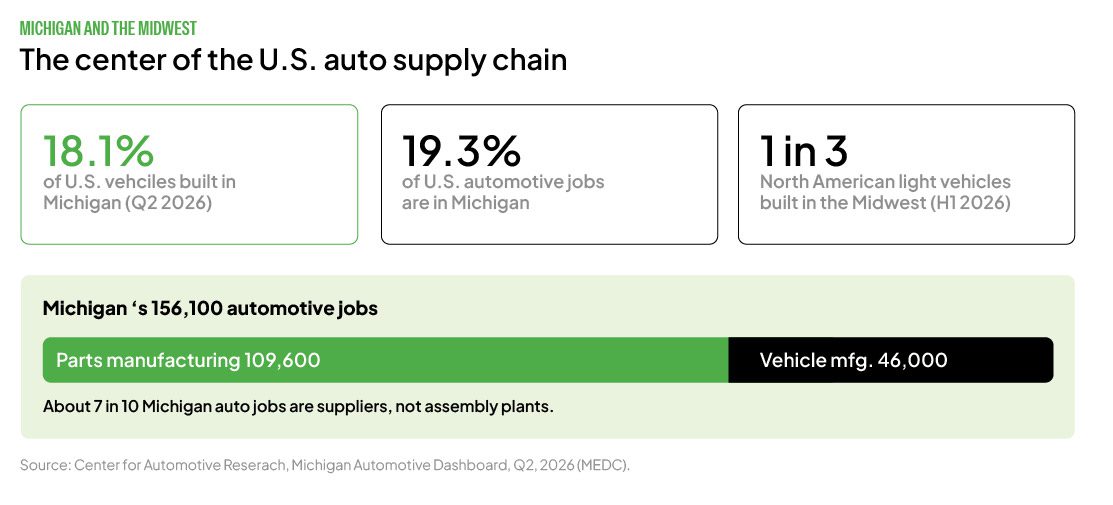
Michigan built 18.1% of all U.S. vehicles in the second quarter of 2026, according to the Center for Automotive Research’s Michigan Automotive Dashboard. The state holds 19.3% of U.S. automotive jobs. Most of those jobs aren’t at vehicle assembly plants, though. Of Michigan’s 156,100 automotive jobs, 109,600 are in auto parts manufacturing.
That supplier network doesn’t stop at the state line. The Midwest produced 2.59 million light vehicles in the first half of 2026, about a third of all North American production. Parts move between machine shops, heat treaters, platers, and coaters across Michigan, Ohio, Indiana, and beyond before they reach final assembly.
Maxum got its start in automotive, right here in Michigan. One problem shows up at almost every stop in that supply chain. Parts come out of a process wet, oily, or dirty, and they need to leave clean and dry.
One Part, Many Plants
A single transmission housing or brake component can pass through several suppliers before it’s installed. One shop machines it. Another heat treats it. A third plates or coats it. Each step leaves something behind, whether it’s coolant, quench oil, rinse water, or process chemistry.
Inside one plant, a wet or dirty part means rework. Between plants, it becomes the next supplier’s problem. That’s where small drying issues turn into rejected shipments, sorting, and quality scores that take time to rebuild.
When Blow-Off Fails
Here’s what gets left behind when blow-off doesn’t do its job, and what it causes further down the line.
| Process | What’s left on the part | What it causes |
|---|---|---|
| CNC milling, grinding, and EDM | Chips and fluid in bores, threads, and pockets | Debris sealed inside engines and transmissions, failed cleanliness checks, bad gauge readings |
| Polishing | Compound and residue | Residue carried into washing, plating, or coating that causes finish defects |
| Laser etching | Oil, dust, and debris on the surface | Faded or unreadable part marks that break traceability |
| Stamping | Stamping lubricant | Poor weld quality and coatings that don’t stick |
| Parts washing | Rinse water and wash chemistry | Water spots, flash rust, and wet parts packed into dunnage that corrode in transit |
| Heat treat and quench | Oil dripping from hot parts | Slippery floors, wasted oil, and oil carried into the washer |
| Pretreatment and plating | Chemistry dragged from one tank into the next | Contaminated baths, higher chemical and rinse water costs, staining, and more wastewater |
| Paint and powder coat | Leftover moisture or oil | Fisheyes, blistering, weak adhesion, and higher oven energy |
Machining Leaves More Than Chips
CNC milling, grinding, and wire EDM all use fluids, and those fluids end up in every bore, thread, and pocket. Polishing adds compound. Laser etching needs a clean surface to leave a mark a scanner can read, and that mark is often how a part is traced through the supply chain.
A flat air knife covers open surfaces well. Recessed features need concentrated airflow aimed right where the debris sits. That’s why Maxumizer® Air Nozzles often run alongside air knives on machining lines. Here’s how one manufacturer handled debris after grinding and deburring.
Washing Is Only Half the Job
A parts washer gets the part clean. It doesn’t get it dry. Water left on steel parts can flash rust before they reach the next step, and wet parts packed into returnable dunnage can arrive at the next plant spotted or corroded. Stamped parts carry a similar risk when lubricant isn’t fully removed before welding or coating.
Washer exits are where the Nozzle Bar® Air Knife System does much of its work in automotive plants, including at one of the world’s largest transmission plants. For what happens when wet parts reach the paint line, read Clean Parts Aren’t Dry Parts.
H2: Oil and Chemistry Between Tanks
Heat treating and finishing both run parts through liquid. After quenching, oil drips from hot parts onto the floor and into the next process. Blow-off strips that oil so it can go back into the tank instead of onto the floor.
Pretreatment and plating lines have a similar problem. Each part carries a film of chemistry from one tank into the next, often called drag-out. That dilutes the next bath, raises chemical and rinse water costs, and adds to wastewater. Blow-off between stages pulls that liquid off and keeps it where it belongs, as one chrome plating line found.
What a Bad Lot Really Costs
The American Society for Quality splits the cost of poor quality into two groups. Internal failures are defects caught before the part ships, like rework and scrap. External failures are found by the customer and include returns, transport, and investigation. In the auto supply chain, external failures hurt more because your customer is now involved.
Here’s a simple scenario. A Tier 2 machining supplier ships a lot of 8,000 steel brackets. The customer finds coolant residue and light rust on some parts and puts the lot on hold.
| Cost | Assumption | Estimate |
|---|---|---|
| Sorting labor | 8,000 parts at 80 parts per hour, or 100 hours at $23.35 per hour* | $2,335 |
| Rewash and redry | 15% of the lot (1,200 parts) at $0.50 per part | $600 |
| Scrap | 2% of the lot (160 parts) with rust, at $12 per part | $1,920 |
| Expedited freight | Replacement parts shipped at premium rates | $1,500 |
| Total for one lot | $6,355 |
Median hourly pay for quality control inspectors, U.S. Bureau of Labor Statistics, May 2025. Other figures are illustrative assumptions.
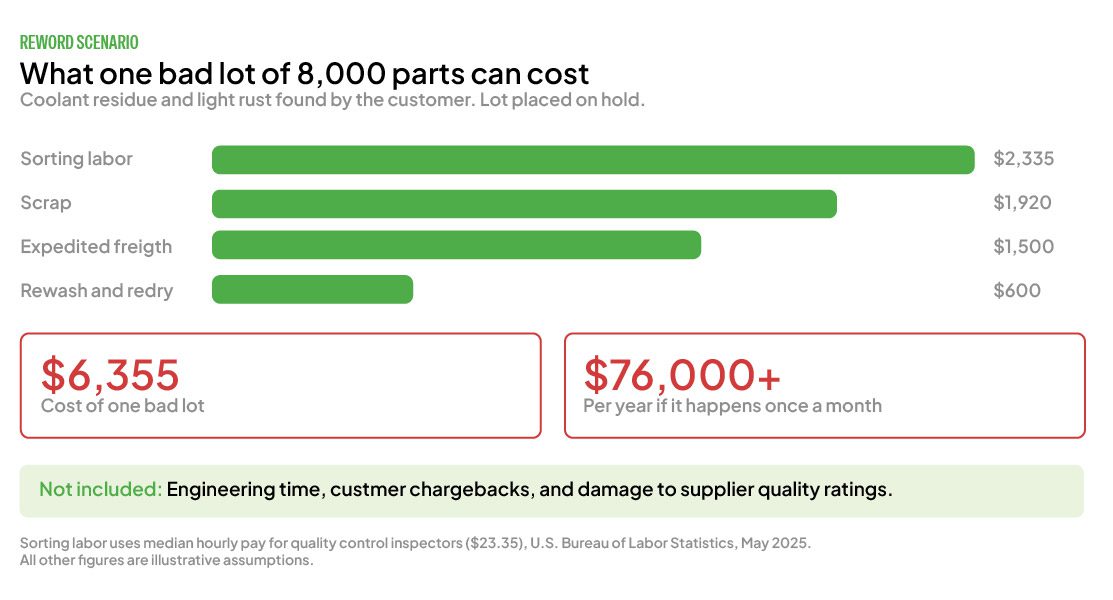
If that happens once a month, it adds up to more than $76,000 a year. That doesn’t include engineering time, customer chargebacks, or the hit to your supplier quality rating. A properly sized blow-off system addresses the problem before the part leaves your dock.
Rethink Your Air. Rethink Your Supply Chain.
The Midwest auto industry runs on handoffs. Every supplier depends on the one before it to ship clean, dry parts. When blow-off works, nobody notices. When it doesn’t, the cost travels to the next plant.
Maxum designs blow-off systems for machining, washing, heat treat, and finishing lines across Michigan and the Midwest. See our Industrial Solutions or contact a Maxum representative to talk through your line.