
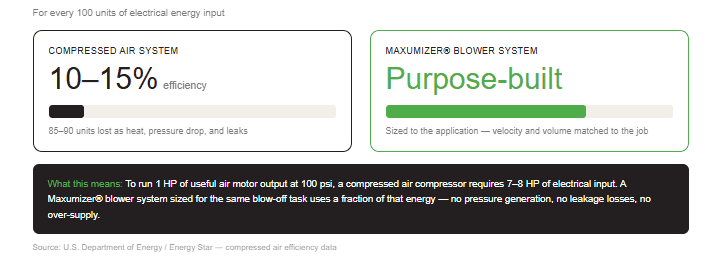
Compressed air runs at 10-15% overall efficiency. That number comes from the U.S. Department of Energy, and it means for every dollar your plant spends generating compressed air, as little as ten cents of that energy is doing useful work at the point of application. The rest leaves as heat, pressure drop, and leaks.
Most facilities know compressed air is expensive. Far fewer have actually calculated what it costs specifically for blow-off, and how that compares to running a dedicated blower system for the same job.
That gap in the math is where significant, recurring cost lives.
Why Compressed Air Became the Default for Blow-Off
Compressed air infrastructure is already on the plant floor. It is piped to workstations, tied into equipment, and familiar to every maintenance tech on the shift. When a moisture or debris problem shows up on the line, the fastest fix is to tap into the nearest airline.
We see it constantly: a section of pipe with holes drilled into it, pointed at a conveyor or a part coming out of a washer. It solves the immediate problem. The cost of running that setup continuously against an already-loaded compressor rarely gets tracked against the blow-off application that caused it.
That is the first hidden cost. Not the equipment. The runtime.
What 10-15% Efficiency Actually Means on Your Energy Bill
To run a 1-horsepower air motor at 100 psi, a compressed air system requires 7-8 horsepower of electrical input at the compressor. That ratio holds whether you are driving a pneumatic tool or blowing water off a conveyor belt.
On top of that, the DOE estimates leaks alone account for 20-30% of a compressor's total output in a typical industrial facility. In a plant running continuous blow-off from the compressed air system, a meaningful portion of the energy going into the compressor is not even reaching the application.
The numbers look different by region, but the efficiency gap does not change. Industrial electricity rates vary across Maxum Air's core markets. According to the Michigan Public Service Commission's June 2026 rate data, large industrial customers served by DTE Electric pay between 8.88 and 10.97 cents per kWh. In the Southeast and Mid-Atlantic, where food processing and beverage operations are concentrated, industrial rates run higher.
The efficiency problem compounds as rates rise. Industrial electricity costs increased 8.6% year over year as of February 2026 per EIA reporting. What cost a plant $40,000 per year in compressed air energy two years ago costs more today, with no change to the application.
U.S. Industrial Electricity Rates Are Only Going Up
That rising rate trend matters more than most plant managers account for when evaluating equipment decisions. A blow-off application running on compressed air today will cost more to run next year, and the year after, with no changes to the line.
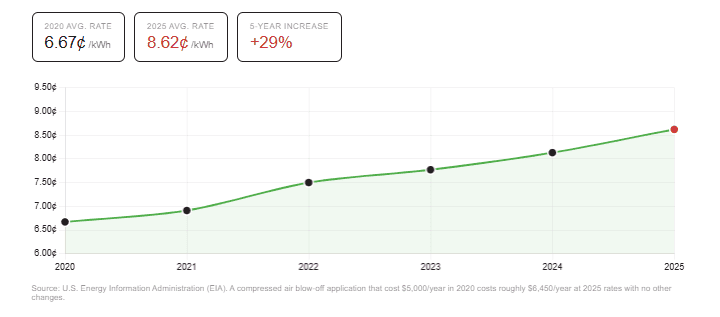
From 2020 to 2025, the U.S. average industrial electricity rate climbed 29%, from 6.67 cents to 8.62 cents per kWh per EIA data. That trend is projected to continue. Running the math on a compressed air blow-off application at 2020 rates significantly understates what it costs today, and what it will cost over a 3-5 year equipment horizon.
Side-by-Side: What the Numbers Actually Look Like
The table below maps estimated annual energy cost for a continuous 10 HP blow-off application across five electricity rate scenarios and three operating day schedules. Each rate group shows the compressed air cost, the Maxumizer® Air Blower cost, and the estimated annual savings side by side.
Application assumed
10 HP continuous blow-off
Compressed air input
75 HP at compressor
Blower system input
10 HP at blower motor
| Rate (¢/kWh) | System | 200 days | 300 days | 365 days |
|---|---|---|---|---|
| 8¢ (MI large industrial) | Compressed air | $7,162 | $10,742 | $13,069 |
| Maxumizer® blower | $955 | $1,433 | $1,743 | |
| Est. savings | $6,207 | $9,309 | $11,326 | |
| 10¢ (US industrial avg.) | Compressed air | $8,952 | $13,428 | $16,337 |
| Maxumizer® blower | $1,194 | $1,791 | $2,179 | |
| Est. savings | $7,758 | $11,637 | $14,158 | |
| 12¢ (mid-range est.) | Compressed air | $10,742 | $16,114 | $19,604 |
| Maxumizer® blower | $1,433 | $2,149 | $2,615 | |
| Est. savings | $9,309 | $13,965 | $16,989 | |
| 15¢ (Southeast / commercial) | Compressed air | $13,428 | $20,142 | $24,505 |
| Maxumizer® blower | $1,791 | $2,687 | $3,268 | |
| Est. savings | $11,637 | $17,455 | $21,237 | |
| 20¢ (Northeast / higher tier) | Compressed air | $17,904 | $26,856 | $32,674 |
| Maxumizer® blower | $2,388 | $3,582 | $4,358 | |
| Est. savings | $15,516 | $23,274 | $28,316 |
Maxumizer® blower annual cost
Estimated annual savings
Based on DOE efficiency data: 75 HP compressor input for 10 HP output at 10-15% system efficiency vs. 10 HP Maxumizer® blower motor. 8 hrs/day operating. Actual savings depend on your specific application, compressor load, and local rate. Contact Maxum for an application-specific calculation.
At the most conservative scenario, 8 cents per kWh and 200 operating days, the savings are still meaningful. At 12 cents and 250 days, a common mid-range scenario for Midwest manufacturing, the gap exceeds $5,000 per year on a single application. Plants running multiple compressed air blow-off stations multiply that figure accordingly.
Maxumizer® Air Blower systems are engineered to reduce energy use for blow-off applications by 30-70% compared to compressed air setups. That range reflects real-world variation across application types and line configurations.
The Costs That Don't Show Up on the Energy Bill
Energy is the largest cost category, but not the only one.
Compressor wear from continuous blow-off duty. Compressed air compressors are sized and maintained for their core process loads. When a blow-off application runs continuously against that system, it adds duty cycles the equipment was not specced to carry indefinitely. Maintenance intervals shorten. Replacement timelines accelerate.
Capacity consumed by blow-off can't serve production tools. Every CFM going to a blow-off pipe is CFM unavailable to pneumatic tools, cylinders, or automation equipment elsewhere on the line. Facilities running tight on compressor capacity add new equipment rather than audit where existing capacity is going.
Leak losses compound over time. The DOE's 20-30% leakage estimate applies to the system overall. A blow-off setup built from drilled pipe and quick-connect fittings tends to leak more than properly engineered distribution. Every pound of leakage is energy purchased and wasted before it reaches the application.
None of these costs appear on a budget line labeled "blow-off." They show up as higher maintenance spend, premature capital replacement, and line efficiency issues that trace back to a compressor working harder than it should.
Where the Switch Delivers the Fastest ROI
Not every compressed air application should move to a blower system. Compressed air makes sense for intermittent, high-pressure needs like pneumatic cylinders and tooling. The ROI case for switching is strongest where compressed air is running continuously for blow-off.
The highest-impact applications across Maxum's customer base:
- Post-washer drying before coating or painting. Wet parts entering a powder coat or paint oven cost energy to dry and produce quality defects. A Maxumizer® system paired with Nozzle Bar® Air Knife devices at the washer exit removes bulk liquid before it becomes an oven problem. Automotive plants across Michigan, Indiana, and Ohio run this configuration. See the Powder Paint Blow-Off Success Story.
- Pre-label moisture removal on beverage lines. Residual moisture before inkjet coding or label application causes adhesion failures and rework. Beverage and bottling operations in Georgia, Missouri, and Wisconsin have moved this step to blower-driven air knives. See Beverage Solutions and the Beer Case Can Blow-Off Success Story.
- Debris and chip removal after machining. Compressed air at a grind or deburr station runs continuously and typically leaks from improvised setups. A fixed blower system with air knife coverage handles the same job at a fraction of the compressor load. See Industrial Solutions and the Industrial Grind Deburr Blow-Off Success Story.
- Pre-packaging drying in food processing. Moisture on product before packaging causes labeling failures, weight variation, and contamination risk. Food processors across Illinois, Texas, and the Southeast use blower-driven systems because compressed air quality standards for direct food contact add additional cost and compliance exposure. See Food Solutions.
How to Know If the Switch Makes Sense
The calculation is not complicated. Four inputs are all you need:
- The horsepower of compressed air currently dedicated to blow-off, or the CFM and pressure being consumed
- Your plant's annual operating hours for that application
- Your local industrial electricity rate, available from your utility bill or energy manager
- Your current annual compressor maintenance spend
From those four numbers, Maxum's team can build an application-specific comparison against a properly sized Maxumizer® Air Blower system. The engineering is done before the quote. You get the cost side by side, not a sales estimate.
For a starting benchmark: Michigan large industrial customers pay 8.88-10.97 cents/kWh per MPSC June 2026 data. The U.S. industrial average runs 8-10 cents nationally per EIA, with Northeast and Southeast accounts often higher depending on tier and contract. Industrial rates rose 8.6% year over year as of early 2026. Running that trend forward over a 3-5 year equipment horizon changes the payback math significantly.
Rethink Your Air. Rethink Your Budget.
Compressed air will always have a place on the plant floor. The question is whether it belongs on your blow-off application, running continuously, carrying an efficiency penalty that costs your operation thousands of dollars per year in energy it never delivers.
A properly configured Maxumizer® Air Blower system, paired with the right Maxumizer® Air Knife or Nozzle Bar® Air Knife configuration for your line, solves the same problem with a fraction of the energy input. The Bearing Bridge drive system reduces maintenance requirements compared to direct-drive compressed air setups, and the stainless steel construction holds up in the industrial environments where these systems run every shift.
The cost you are not calculating is real. It is showing up in your energy spend, your maintenance budget, and your compressor capacity. It is just not on a line item that says "blow-off."
Contact Maxum to run the numbers on your specific application.