
The World Is Watching Both of Them, and the Bottling Line Has to Keep Up
Kentucky exported $799 million in distilled spirits in 2025. Tennessee was right behind at $793 million. Together, those two states account for more than half of total US distilled spirits export revenue, per the Distilled Spirits Council of the United States. The product those states are selling — bourbon and Tennessee whiskey — now ships to 278 countries, with Brazil, Japan, Australia, and the UK among the fastest-growing markets.
That reach did not happen by accident. It happened because American spirits built a reputation for quality that international buyers trust. Maintaining that reputation starts long before the bottle reaches a port. It starts on the bottling line.
Kentucky and Tennessee Own the Global Spirits Market
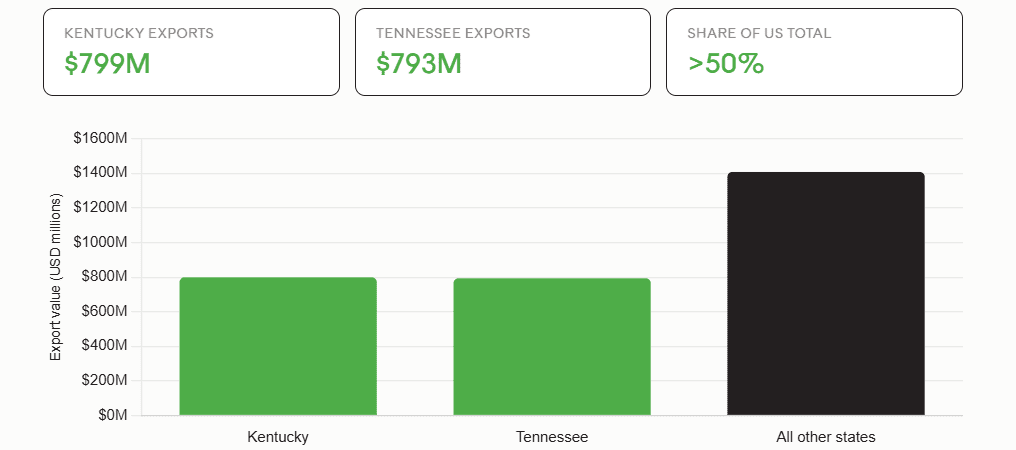
Brown-Forman, the parent company of Jack Daniel's Tennessee Whiskey, generated 58% of net sales internationally in fiscal 2026, selling across more than 170 countries. Brazil joined the US, UK, and Germany as a million-case market for the Jack Daniel's family of brands in fiscal 2025. Emerging markets grew more than 20% organically. Kentucky accounts for approximately 95% of global bourbon production, with 17.1 million aging barrels in warehouses across the state.
The question is not whether global demand exists. The question is whether the bottling infrastructure can meet that demand at the quality level international buyers expect.
The Trade War Complication
American whiskey exports to the EU dropped 35% in 2025, driven by trade friction and a surge of front-loading in late 2024 ahead of threatened tariffs. The EU's proposed 30% tariff is currently suspended through August 2026, Canada pulled US spirits from most provincial shelves, and domestic sales are slowing with inventory at record highs per DISCUS. Emerging markets in Brazil, the UK, and Southeast Asia are growing, but pressure on two fronts simultaneously changes the economics of every bottle that rolls off a bottling line. When margins tighten, production efficiency and label quality become more important, not less. Full export breakdown: DISCUS 2025 American Spirits Exports Report
What a High-Volume Spirits Bottling Line Actually Looks Like
The bottling line is where bourbon or Tennessee whiskey becomes a retail-ready unit that has to meet the labeling, coding, and packaging standards of 278 different markets. A bottle exits the filler, gets capped or corked, then moves through inkjet coding and label application before final inspection and case packing.

Each of those steps has a moisture dependency most bottling operations underestimate. Glass bottles coming off a high-speed rinse or from refrigerated storage carry rinse water or condensation on the exterior. Residual moisture before inkjet coding causes the ink to spread or fail to cure on the glass. Moisture before pressure-sensitive label application prevents the adhesive from bonding cleanly.
For bottles headed to the EU, UK, or Japan, label integrity and coding accuracy are inspected at the point of entry. A mislabeled or improperly coded bottle is not a domestic rework problem. It is an international customs problem.
The Pre-Label Moisture Problem at Production Scale
Maxumizer® Air Knives deliver air velocity in the 200-500 mph range at the point of application, stripping moisture from the bottle exterior at line speed. A properly configured Maxumizer® Air Blower system efficiently provides surface dryness before the bottle reaches the coder or labeler. Compressed air from drilled pipe waste tremendous energy and may only achieve 50-60% dryness, leaving residual moisture that creates downstream defects.
At $50-$80 per bottle on premium bourbon, the cost of a rejected label is not a rounding error. That math applies equally to large commercial distilleries running multiple shifts and smaller craft operations bottling single-barrel product headed to Tokyo or Frankfurt. The per-bottle value only makes the case for precision stronger. See Beverage Solutions and the Beer Case Can Blow-Off Success Story for how this application works at different production scales.
Why the Bottling Line Matters More for Smaller Distilleries
Over 2,500 active craft distilleries operated across the US in 2024, many of the fastest-growing in Kentucky and Tennessee. These operations bottle at lower volumes but with high per-bottle value on single-barrel, small-batch, and age-stated products. A label failure on a $60 bottle of small-batch bourbon headed to Tokyo costs more per unit than the same failure on a $12 case of domestic beer. Improvised compressed air setups are common at smaller operations because the upfront cost of a configured blow-off system seems high relative to volume. That calculation changes when you factor in per-bottle rejection rates on premium product and the quality standard required to export to markets where label and coding inspection is rigorous.
Craft distilleries that can bottle to international standards have access to the same 278 countries the large commercial operations serve. The EU tariff decision expected before August 2026 will shape export volumes for the next two years, but the distilleries investing in production line efficiency now are better positioned regardless of which way it goes. Growth in emerging markets requires consistent quality at lower per-case margins. That is where a well-configured bottling line pays for itself.
Rethink Your Air. Rethink Your Line.
Every bottle that leaves Kentucky or Tennessee carries a quality expectation built over decades. The bottling line is where it either meets that standard or does not. Contact Maxum to talk through your specific application — the conversation starts with your line speed, your bottle format, and where your product is going.