
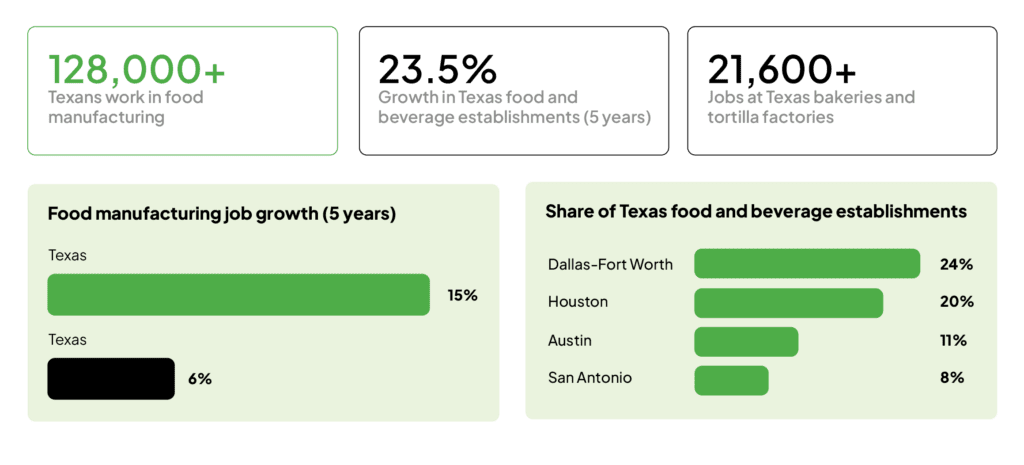
More than 128,000 Texans work in food manufacturing, according to the Texas A&M Real Estate Research Center. Food manufacturing jobs in the state grew 15% over five years, compared with 6% nationally. The number of food and beverage plants grew even faster, up 23.5%.
That growth is spread across the state. Dallas-Fort Worth holds 24% of Texas food and beverage establishments, followed by Houston at 20%, Austin at 11%, and San Antonio at 8%.
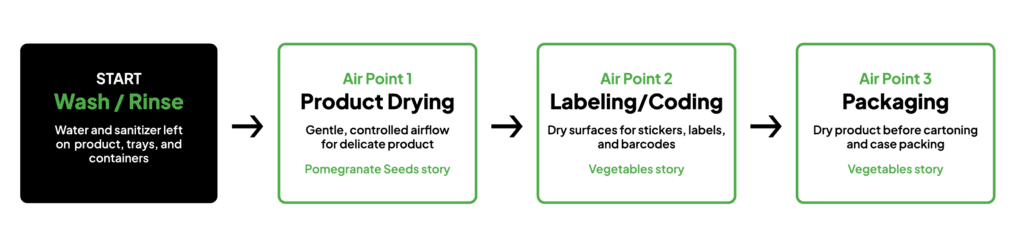
More plants and faster lines bring a familiar problem. Food lines wash constantly, and the water has to go somewhere. When it stays on product, trays, or containers, it shows up later as a wet floor, a soft carton, or a slower line.
Where Moisture Hits a Food Line
In our experience, moisture problems during food processing and packaging tend to show up in several places.
- After washing reusable trays and pallets, before they go back into production
- Before cartoning or case packing, when wet product can weaken the package
- On delicate product that needs to dry without damage
Each one has a real fix behind it.
Wet Trays and Pallets Leave a Trail
Meat processing plants move products on reusable trays and pallets, and both go through a wash station before going back into service. One major beef producer carried dirty stainless-steel trays on plastic pallets from the processing area to a remote wash station. After washing, rinse water and sanitizer followed the pallets back out. That wasted chemicals and left a wet trail across the production floor.
The customer installed two sets of Nozzle Bar® Air Knives with a 40 HP Maxumizer® Air Blower. The first set sits after the wash zone and acts as a containment curtain, pushing chemicals back into the tank. The second set sits after the rinse to dry the pallets before they return to the line.
Keeping more sanitizer in the tank cuts both fresh rinse water use and sanitizer consumption. The final blow-off stage nearly eliminated the wet trail on the floor, which improved the work environment and worker safety. Read the full Meat Tray and Pallet Blow-Off Success Story.
The same setup works anywhere a plant washes reusable containers, trays, or pallets before sending them back into production.
Wet Packaging Doesn’t Survive the Trip
A produce packer washed grape tomatoes before packing them. The water left on the fruit created a condition where mold and mildew could form in the plastic and Styrofoam containers during shipment and storage.
The fix was Nozzle Bar® Air Devices powered by a Maxumizer® Air Blower, positioned to remove the droplets before packaging. The Nozzle Bar® Air Knife System is the most common setup on high-speed food packaging lines because its nozzle design keeps airflow consistent at line speed.
Removing the droplets before packaging addressed the issue, and the plant saw faster production, better product quality, and higher customer satisfaction
Rinse water and condensation left on most produce can soak into cardboard and paper containers and weaken or completely damage them. The Nozzle Bar® Air Knife System solves these common issues, speeding up production and improving delivered product quality.
Texas adds its own pressure. Product packed around Houston and the Gulf Coast often ships long distances through humid air. Cold products or containers moving into a warm, humid space can collect condensation. Moisture-free packaging starts on the line, not in the warehouse.
Drying Delicate Product Safely
Some products can’t take a hard blast of air. A pomegranate seed processor had mechanically peeled seeds clumping on the conveyor, leaving pools of water and juice behind. An older fan-style blower wasn’t keeping up.
The plant replaced it with a Maxumizer® Air Blower and a series of Maxumizer® Air Knives. The knives gently move the clumps and push liquid through the conveyor mesh without damaging the seeds. Production sped up and product quality improved.
The same approach works for rice, pasta, candy coatings, and other products where airflow needs careful control. After the fryer, high-velocity air also removes excess surface oil and crumbs from snack chips, fried foods, and the conveyor belts themselves.
The Real Cost of Compressed Air
Many food plants still blow off with house compressed air. It’s already on the floor, so it’s an easy fix. It’s also expensive. The U.S. Department of Energy puts compressed air system efficiency at just 10-15%. Most of the energy you pay for never reaches the product.
One commercial bakery supplies breads, croissants, biscuits, and English muffins to customers nationwide. It used a compressed air knife to clean baking pans before the cooling tunnel. Bread particles stayed on the pans, causing buildup and line disruptions, and the plant used extra energy trying to compensate.
The bakery switched to a Maxumizer® L07E Air Blower with the Nozzle Bar® Air Knife System and stopped using house compressed air for the job. The result was significantly lower electrical use, cleaner pans, and less downtime. The bakery then added more systems at that plant and expanded to multiple other U.S. locations.
That matters in Texas, where bakeries and tortilla makers provide more than 21,600 jobs. For the full energy math, see Compressed Air vs. Blower Air.
Rethink Your Air. Rethink Your Packaging.
Texas food manufacturing keeps growing across Dallas-Fort Worth, Houston, Austin, and San Antonio. The moisture problems stay the same. Wet trays and pallets spread water and chemicals. Wet packaging breaks down. Delicate products need careful drying. And compressed air costs more than most plants realize.
Each of those problems has a fix that has already worked on a real food line. Visit our food solutions to see where Maxum fits, or contact a Maxum representative to talk through your line.